
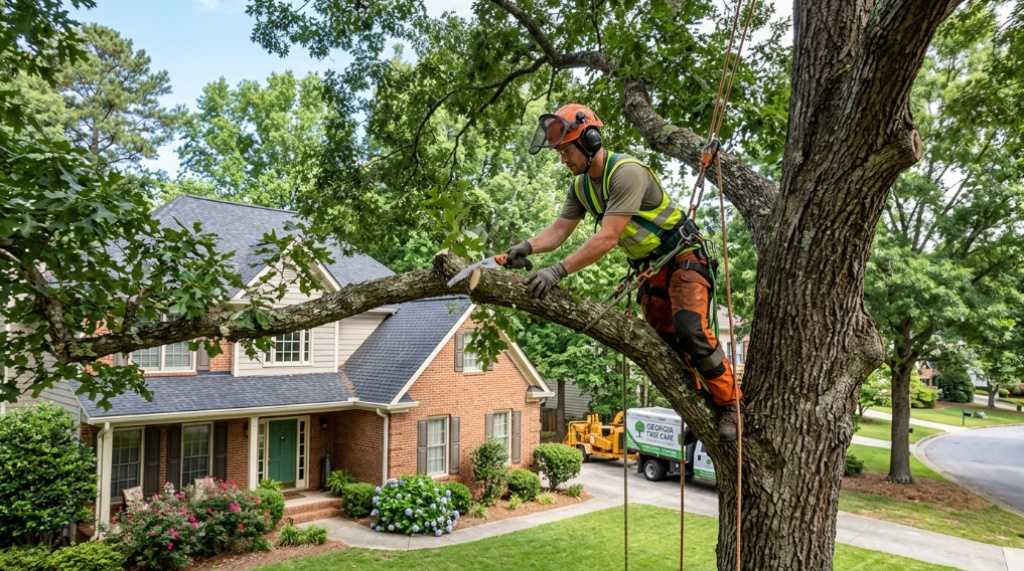
Georgia’s warm, humid climate is a gift to trees. Oaks, pines, maples, and pecans grow fast here—often faster than homeowners expect. That low-hanging limb over the driveway you noticed last spring can become a scraping hazard by fall, and the crape myrtle that looked tidy two years ago may now be blocking your windows. If you’re weighing whether to grab a pole saw, hire an arborist, or pick up a compact cordless tool for lighter cleanup work, it helps to understand what Georgia’s rules, tree species, and seasonal timing actually demand. For smaller limbs and routine trimming, many homeowners first read the full Tietoc chainsaw review to see whether a mini electric saw fits their needs. This guide walks through the practical decisions: safety limits, legal considerations, cutting technique, and when to call a professional instead.
Quick Answer
Handle overgrown branches in Georgia by first checking whether the limb is on your property or a neighbor’s, then assessing size and proximity to power lines. Limbs under about 3 inches in diameter can usually be cut with a handheld or pole saw if you have clear footing and no overhead wires. Anything near utility lines, larger than 6 inches, or requiring you to climb should go to a licensed arborist. In Georgia, the safest windows for most pruning are late winter and early spring before new growth, though dead or hazardous limbs should be removed any time.
Key Takeaways
- In Georgia, limbs touching or near power lines are never a DIY job—call Georgia Power or a utility-approved arborist.
- Late winter (February to early March) is ideal for structural pruning on most Georgia hardwoods, but dead, cracked, or storm-damaged limbs should come down immediately.
- You can legally cut branches that overhang your property in most Georgia cases, but you generally cannot enter a neighbor’s yard or destroy the tree without permission.
- A 6-inch mini electric chainsaw handles small limbs and yard cleanup well but is not designed for large trunks or extended overhead work.
- The three-cut method prevents bark tearing and makes clean wounds that heal faster on Georgia’s fast-growing species.
Why Overgrown Branches Are a Bigger Deal in Georgia Than You Might Think
Georgia’s growing season is long, and its humidity encourages rapid, dense growth. A red maple that adds a foot of height per year in a cooler state can put on significantly more here. That means limbs you trimmed last year may already be back near your roof, your fence, or your power drop.
There’s also the storm factor. Georgia sees its share of thunderstorms, tropical remnants, and occasional ice events—even in the Piedmont and north Georgia mountains. A limb that looks fine in July can become a projectile in an August squall. Overgrown branches also invite pests: carpenter ants, termites, and borers are more likely to move from tree to house when branches touch the structure.
Finally, Georgia has specific trees worth knowing. Water oaks and willow oaks are notorious for dropping large limbs without warning. Bradford pears, though popular, split easily once they mature. Knowing your tree species changes how aggressive you should be about pruning.
Assessing the Situation Before You Cut Anything
Before you pick up any tool, walk the property and answer four questions for each problem branch.
- Whose property is it on? In Georgia, the trunk’s location usually determines ownership—not where the branches hang.
- How big is the limb? Diameter determines tool choice and risk level.
- What’s underneath? Roofs, cars, fences, and power lines change the calculation entirely.
- Is the tree healthy? Pruning a dying tree may be wasted effort; removing it may be the better call.
Branch size and what it means for your approach
| Limb Diameter | Typical Approach | Risk Level |
|---|---|---|
| Under 1 inch | Hand pruners or loppers | Low |
| 1–3 inches | Pole saw or compact electric chainsaw | Low to moderate |
| 3–6 inches | Gas or corded chainsaw, careful footing | Moderate |
| Over 6 inches | Professional arborist recommended | High |
| Any size near power lines | Utility company or certified arborist only | Extreme |
This table isn’t a hard rule, but it reflects the general reality: as limb size grows, the consequences of a mistake grow faster. A 2-inch limb that falls the wrong way dents a gutter. A 10-inch limb can crush a car or worse.
Georgia Rules You Should Know Before You Cut
Georgia follows a fairly common legal principle: you may trim branches that extend over your property line, but only up to the property line. You cannot cross onto a neighbor’s land to do it, and you cannot cut so aggressively that you kill or seriously harm the tree.
Some specific points that trip people up:
- If the tree dies because of your cutting, you may be liable for its replacement value—which for a mature Georgia hardwood can be thousands of dollars.
- If a neighbor’s limb falls on your property, it’s generally your responsibility to clean up, not theirs, unless they were negligent.
- Boundary trees—those growing on the property line itself—are jointly owned and require cooperation.
- HOAs in Georgia often have their own tree rules that are stricter than state law. Check before you cut.
When in doubt, a short conversation with the neighbor beats a dispute later. Written documentation (a text, an email) helps if the situation ever escalates.
What about protected trees?
Some Georgia municipalities—including parts of metro Atlanta, Savannah, and Athens—have tree ordinances that protect certain species or trees above a specific trunk diameter. Removing or heavily pruning one without a permit can trigger fines. If your tree is large and you’re unsure, a quick call to your city or county planning office clears it up, If you are planning major backyard renovations to clear space for new landscaping or outdoor workspaces, remember that a garden office can extend your family living space outdoors.
The Right Time to Prune in Georgia
Timing matters more in Georgia than in colder states because the growing season runs long.
- Late winter (February–early March): Best for structural pruning on oaks, maples, and most shade trees. Trees are still dormant, and wounds close quickly as spring growth begins.
- Early summer: Acceptable for minor corrective cuts on flowering trees after bloom.
- Fall: Generally avoid for oaks. Georgia has concerns about oak wilt spread, and fresh wounds in mild fall weather can attract pests.
- Anytime: Dead, broken, or storm-damaged limbs should come down regardless of season.
One Georgia-specific note: if you have pine trees, remember that pines produce their growth in a single flush each spring. Pruning them heavily during the growing season can leave permanent gaps.
Step-by-Step: Safely Removing an Overgrown Limb
This applies to limbs you can safely reach from the ground or a stable ladder—not to overhead work near wires.
- Plan the drop zone. Look up and down. Where will the limb fall? Clear people, pets, and vehicles from that area.
- Put on safety gear. Eye protection, gloves, and hearing protection if you’re using a chainsaw. A hard hat if anything is overhead.
- Make the undercut. About 12–18 inches from the trunk, cut upward into the bottom of the limb about one-third of the way through. This prevents bark tearing.
- Make the top cut. A few inches further out from the undercut, cut down until the limb falls. The undercut protects the trunk.
- Remove the stub. Cut the remaining stub back to the branch collar—the swollen area where the branch meets the trunk. Don’t cut flush; leave the collar intact.
- Don’t paint the wound. Georgia’s warm, humid air actually helps trees seal wounds naturally. Wound paint traps moisture and can encourage decay.
A quick note on mini electric chainsaws
Compact battery chainsaws—including 6-inch mini models—are genuinely useful for limbs under a few inches, storm cleanup, and cutting branches into manageable pieces for yard waste pickup. They’re lighter, quieter, and easier to control with one hand than a full-size saw. What they are not: a substitute for a pole saw when reaching overhead, or a tool for anything approaching trunk-sized wood. For a realistic look at what a compact saw can and can’t do before you buy one, read the full Tietoc chainsaw review to see whether its size and power match the work you’re planning.
When to Call a Professional Arborist Instead
Some jobs are worth the money. Call a licensed, insured arborist—ideally ISA-certified—if any of these apply:
- The limb is within 10 feet of a power line, cable, or phone line.
- The branch is larger than 6 inches in diameter.
- You’d need to climb the tree or work from a roof to reach it.
- The tree is leaning, cracked, or showing signs of disease.
- The limb overhangs a structure you can’t afford to damage.
- You’re not confident about which way the limb will fall.
A typical Georgia arborist visit for pruning a few limbs may run a few hundred dollars. Removing a large hazardous tree can run into the thousands. That feels expensive until you compare it to an emergency room visit or a roof repair.
How to vet an arborist in Georgia
Ask for proof of liability insurance and workers’ compensation coverage. Confirm ISA certification. Get the quote in writing with a clear scope—are they hauling away debris? Are they grinding stumps? A written estimate prevents a lot of awkward conversations later.
Disposal and Cleanup
Georgia communities handle yard waste differently. Many metro Atlanta counties offer curbside pickup for limbs under a certain size (often 4 feet long and a few inches thick), typically bundled. Others require you to haul debris to a county convenience center. Some cities run chipper services on a schedule.
Check your county or city website before piling branches at the curb—putting them out wrong can result in a citation. If you have a lot of material, renting a chipper for a day or hiring a service to chip on-site can be cheaper than multiple disposal trips.
Frequently Asked Questions
Can I cut branches that hang over my property from a neighbor’s tree in Georgia?
Generally yes, but only up to the property line. You cannot enter your neighbor’s yard without permission, and you cannot cut so much that you harm or kill the tree—doing so can make you liable for its value.
What’s the best time of year to prune trees in Georgia?
Late winter, roughly February to early March, works best for most shade trees because they’re dormant and wounds close quickly as spring growth starts. Dead or hazardous limbs should be removed immediately regardless of season.
Can I use a mini electric chainsaw for tree branches?
Yes, for limbs roughly 1 to 3 inches in diameter and for cutting fallen branches into smaller pieces. Mini electric saws are not designed for large limbs, overhead work near wires, or any job requiring extended reach.
Who is responsible if a neighbor’s branch falls on my house in Georgia?
In most cases, the homeowner where the damage occurs is responsible for cleanup, unless the neighbor was negligent—for example, they knew the tree was dead and dangerous and did nothing. Documenting the tree’s condition beforehand matters.
Do I need a permit to remove a tree in Georgia?
It depends on where you live. Many Georgia cities and some counties have tree ordinances that protect certain species or trees above a specific trunk size. Check with your local planning or code enforcement office before removing a large tree.
How do I know if a branch is too dangerous to cut myself?
If it’s near power lines, larger than about 6 inches in diameter, requires climbing, or overhangs something valuable that you can’t risk damaging, stop and call a licensed arborist. The math rarely favors DIY in those situations.
Conclusion
Overgrown branches around a Georgia home are a normal part of owning property in a state where trees grow enthusiastically. The key is matching your approach to the actual risk: small limbs and routine cleanup are well within reach for most homeowners with a compact saw and some basic technique, while anything near power lines, larger than 6 inches, or requiring climbing belongs in the hands of a certified arborist. Prune in late winter when you can, remove hazards immediately when you must, and talk to your neighbor before disputes start. Do that, and your trees stay healthy and your home stays safer through every Georgia storm season.


