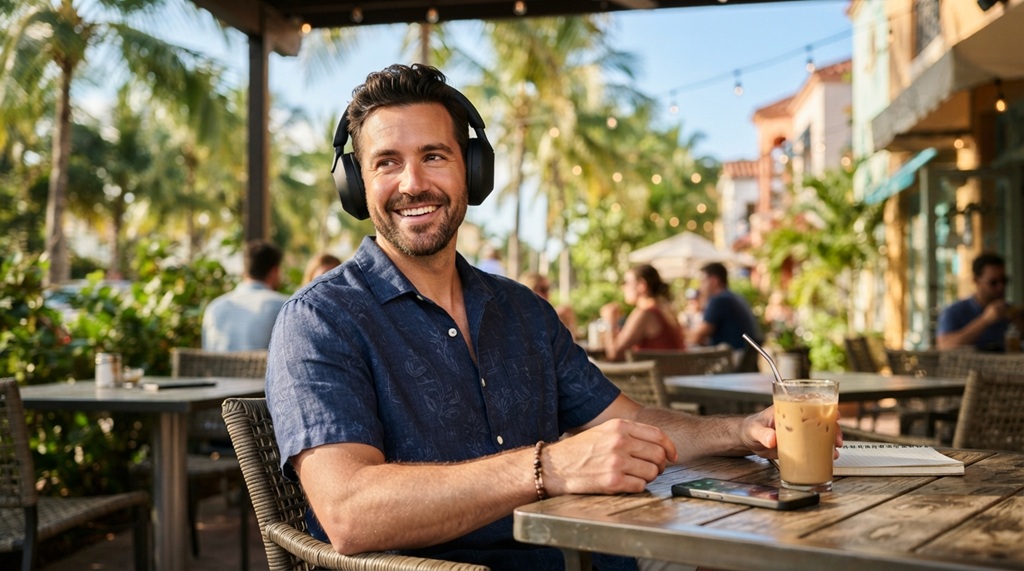
There’s nothing worse than your headphones dying right in the middle of a long flight to Miami, a beach day in Clearwater, or during a remote work session in Orlando. The heat, the humidity, and the sheer amount of time Floridians spend outdoors mean your gear needs to keep up with your lifestyle. If you are tired of scrambling for a charger, you need to focus on battery life above all else. This guide will walk you through exactly how to find long battery wireless headphones that can handle the Florida heat, your daily commute, and everything in between, without wasting money on models that don’t deliver.
Why Battery Life Matters More in Florida
Florida presents unique challenges that make battery longevity a non-negotiable feature. It isn’t just about convenience; it’s about reliability in specific environments.
The Heat Factor and Battery Drain
Lithium-ion batteries are sensitive to high temperatures. When you are sitting on a sunny beach in Sarasota or walking through a theme park in August, the ambient heat can cause your battery to drain faster than it would in cooler climates. Furthermore, heat can degrade the battery’s overall lifespan over time. Investing in a pair of headphones with a massive battery reserve means you won’t be caught off guard when the Florida sun starts taking its toll on your device’s chemistry.
Longer Distances and Commutes
Florida is a sprawling state. Commutes often involve long stretches of highway driving or lengthy train rides on the Tri-Rail or SunRail. If you are using noise-canceling headphones to survive a two-hour commute, a battery life of only 6 hours simply won’t cut it. You need a device that can last for multiple days of commuting without needing a top-up, ensuring you are never left in silence (or with the drone of traffic) on your way home.
Navigating Long-Lasting Headphone Specifications
Evaluating long-lasting headphones requires looking past broad marketing claims to examine core power efficiency metrics, such as active noise cancellation draw rates and total playback capacity per single charge. Because manufacturers often test battery longevity under optimal conditions with advanced features disabled, discerning consumers must cross-reference rated milliamp-hour (mAh) capacities and fast-charging protocols against real-world usage patterns. Prioritizing these foundational acoustic and electrical specifications ensures your investment delivers sustained performance over years of daily wear, and for those balancing high-end endurance with strict financial limits, our comprehensive guide on buy quality headphones without overspending offers targeted strategies for maximizing value.
Understanding Battery Ratings
Most manufacturers list two battery figures: one for when Active Noise Cancellation (ANC) is turned on, and one for when it is off. You should always compare the “ANC On” rating because that is how you will likely use them in noisy environments. A pair of headphones with 30 hours of playback with ANC is generally considered the baseline for “long-lasting” today. However, if you want to charge less than once a week, you should look for models that push 40 to 60 hours.
Fast Charging Features
In a state where you might forget to charge your headphones before a day trip, fast charging is a lifesaver. Look for specifications like “10 minutes of charge equals 5 hours of playback.” This feature is incredibly practical for the “grab-and-go” lifestyle common in Florida. It ensures that even if you are running late, you can get enough juice for your drive across the state without waiting around for a full charge cycle.
Carrying Case Battery Packs
If you are considering earbuds, the charging case is the real battery hero. A pair of earbuds might only last 8 hours on a single charge, but with a case, the total can reach 30 or 40 hours. When evaluating earbuds, always look at the “total with case” figure. This is the number that tells you how long you can go without plugging the case into a wall outlet.
Over-Ear vs. Earbuds: Which Lasts Longer?
Your choice between over-ear headphones and earbuds will significantly impact your battery expectations and usage patterns.
Over-Ear Headphones
Over-ear headphones generally have larger physical bodies, allowing manufacturers to fit in bigger batteries. This is why you often see over-ear models boasting 40 to 60 hours of playback. They are ideal for desk work, flights, and stationary listening. However, in the Florida heat, they can get warm and sweaty, which might make you take them off more often, inadvertently saving battery life.
True Wireless Earbuds
Earbuds are more portable and breathable for the Florida climate. While the buds themselves have shorter battery life (usually 6-10 hours), the charging case acts as a portable power bank. The trade-off is that you have to remember to bring the case with you. For running or gym sessions in the humidity, earbuds are often the more practical choice, and the case ensures you have a full charge ready when you return to your bag.
Top Features That Drain Battery (And What to Do)

Understanding what consumes power helps you manage your usage effectively, even if you already own a high-capacity pair.
- Active Noise Cancellation (ANC): This is the biggest battery hog. If you are in a quiet library or a home office, turning ANC off can nearly double your battery life.
- Volume Levels: Listening at maximum volume requires more power. Keeping the volume at 70-80% is better for your hearing and your battery meter.
- Spatial Audio and EQ Settings: Fancy processing features like head-tracking or custom equalizers require additional processing power, which drains the battery faster.
- Transparency Mode: This uses external microphones to let sound in, which consumes almost as much power as ANC. If you don’t need to hear your surroundings, keep it off.
How to Verify Battery Claims Before Buying
Don’t just take the marketing blurb on the box at face value. There are a few ways to ensure you are getting a product that lives up to its promises.
Check for “Real World” Reviews
Look for professional reviews that conduct standardized battery tests. These tests often use a fixed volume level (like 50%) with ANC on to simulate real-world usage. These reviews will often reveal that a claimed 40-hour battery actually lasts closer to 35 hours in practice. This is normal, but it gives you a buffer to work with when deciding between models.
Look for “Quick Charge” Specs
Pay close attention to the specific quick-charge metrics. If a manufacturer claims “5 minutes for 2 hours,” that is a different level of convenience than “15 minutes for 4 hours.” The latter is more useful for a slow morning where you have time to shower before leaving.
Practical Tips for Maximizing Your Headphone Battery
Once you have your long-lasting pair, you can adopt a few habits to keep them running for as long as possible, especially during long Florida weekends.
- Disable ANC when not needed: If you are sitting in a quiet coffee shop in Tampa, turn off ANC to save power.
- Store them properly: Avoid leaving your headphones in a hot car. Extreme heat can permanently damage the battery’s capacity.
- Use the right charger: Use the charger that came with the device or a reputable third-party charger that supports the correct fast-charging protocol.
- Update Firmware: Manufacturers often release firmware updates that optimize battery management. Keep your headphones updated via the companion app.
- Turn off auto-pause: If the sensors that pause music when you remove the headphones are glitchy, they might be activating randomly and draining power. Disable this feature if you notice erratic battery drain.
Choosing the Right Pair for Your Lifestyle
To narrow down your search, consider how and where you will use these headphones most often. If you are looking for a comprehensive list of top performers that are suited for the climate and lifestyle here, you can check out this curated selection of long battery wireless headphones that have been vetted for their performance in warm conditions.
For the Frequent Flyer
If you travel between Miami and Atlanta frequently, you need over-ear headphones with exceptional noise cancellation and a battery life that exceeds 30 hours. You want a pair that can handle a red-eye flight without needing a charge, and that has a wired backup option just in case you run out of juice mid-flight.
For the Beach Goer
For days at the beach, you want something rugged and waterproof. Earbuds with an IPX7 rating or higher are ideal. While the battery life of the buds themselves might be shorter, the charging case protects them from sand and water. Look for a case with a high capacity so you can leave the wall charger at home.
For the Remote Worker
If you are working from home in Jacksonville, you need a headset that can transition from a conference call to a workout. Look for a model with a good microphone and a battery that lasts the entire work week. Over-ear models with 40+ hour battery life are perfect here, as they can handle back-to-back meetings without dropping to 10% by Friday afternoon.
Frequently Asked Questions
Is 30 hours of battery life enough for wireless headphones?
Yes, 30 hours is generally considered the minimum for “long battery life.” This will easily cover a week of commuting (2 hours a day) or a single long-haul international flight. However, if you want to avoid charging weekly, look for models with 40 hours or more.
Does noise cancellation ruin the battery?
No, it doesn’t ruin it, but it significantly reduces it. Turning on ANC typically reduces battery life by 20% to 30% compared to using the headphones without it. For example, a pair that lasts 50 hours without ANC might only last 35 hours with ANC enabled.
Can I use wireless headphones while they are charging?
Yes, most over-ear headphones support “passive” or “wired” listening. If the battery is completely dead, you can usually plug in a 3.5mm audio cable and use them as wired headphones. However, most true wireless earbuds cannot be used while charging because they need to sit in the case.
How long does it take to fully charge wireless headphones?
It varies by model. Most over-ear headphones take 2 to 3 hours for a full charge via USB-C. Earbuds take about 1 to 2 hours for the buds themselves, and the case takes an additional 2 hours. The key is to look for fast-charging specs to minimize downtime.
Do expensive headphones have better battery life?
Not always. While premium brands often have excellent battery optimization, some mid-range models boast the longest battery life on the market (exceeding 60 hours). Price often dictates build quality and noise cancellation quality, but battery capacity is a specification that can be found at any price point.
Conclusion
Finding the right pair of long-lasting headphones in Florida comes down to understanding your habits and the environment. Don’t just look at the highest number on the box; consider how ANC, heat, and your commute will affect that number. Prioritize models with fast charging and a battery life that gives you a buffer aim for at least 30 hours for over-ears and a high-capacity case for earbuds. By focusing on these practical details, you can ensure your soundtrack never stops, no matter how long your Florida adventure lasts.